How Safe Is Limb Lengthening Surgery for Height Increase?
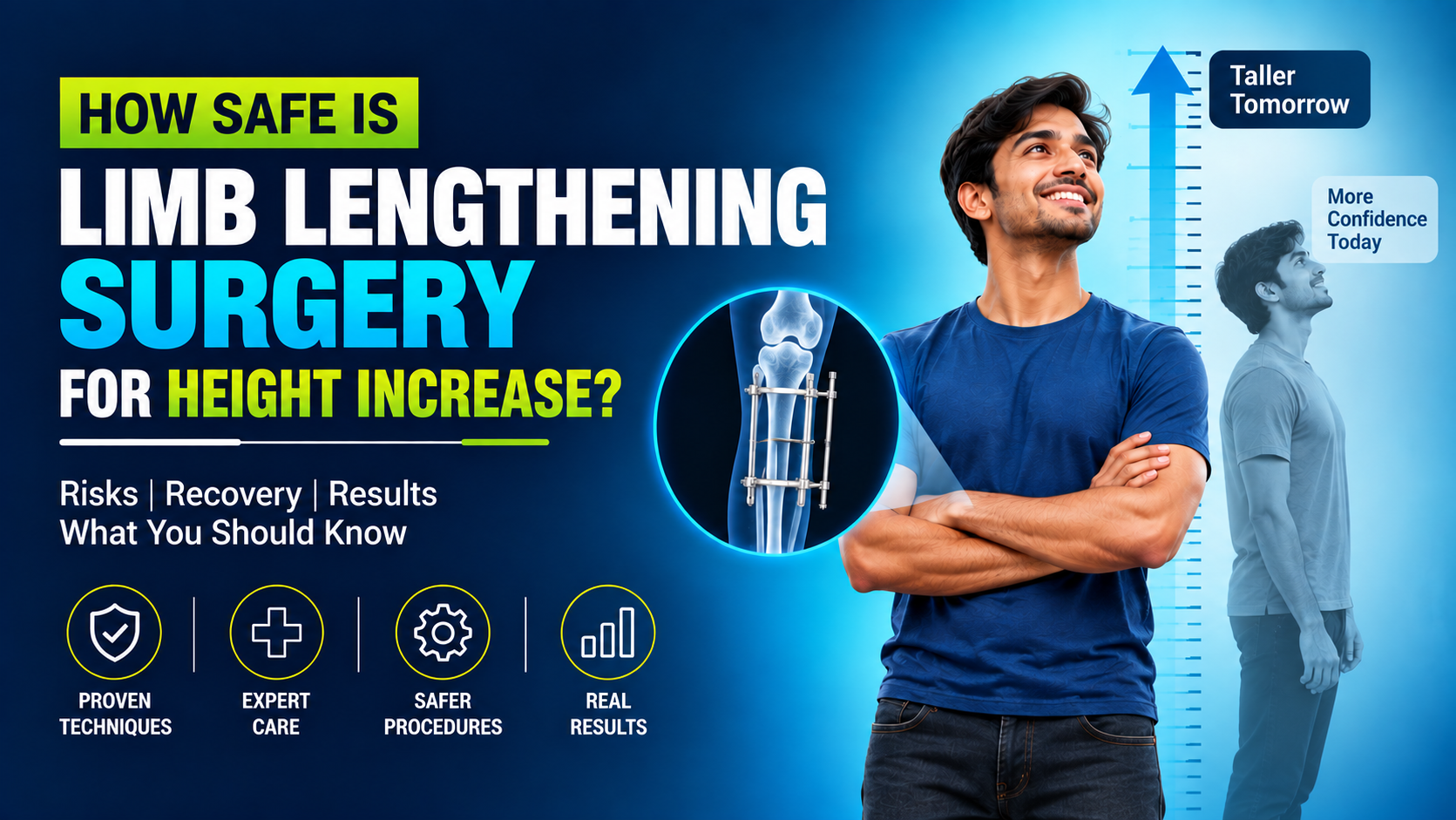
Is Limb Lengthening Surgery Safe for Height Increase?
A Guide by Dr. Soumya Shrikanta Mohapatra, MBBS, MS (Orthopaedics) — Orthopaedic Surgeon at Heights Plus
As an orthopaedic surgeon who has spent over 15 years working in trauma, deformity correction, and limb lengthening, this is the question I get asked more than any other, usually within the first two minutes of a consultation: is this actually safe?
It's a fair question, and honestly, it deserves a fair answer rather than a marketing one. Limb lengthening is a real surgical procedure with real risks, not a cosmetic shortcut. But it's also a procedure that, in experienced hands, has been refined over decades and now carries a strong safety record when done correctly. This article walks through what the evidence actually shows, where the real risks lie, and what separates a safe outcome from a poor one.
What Happens During Limb Lengthening Surgery
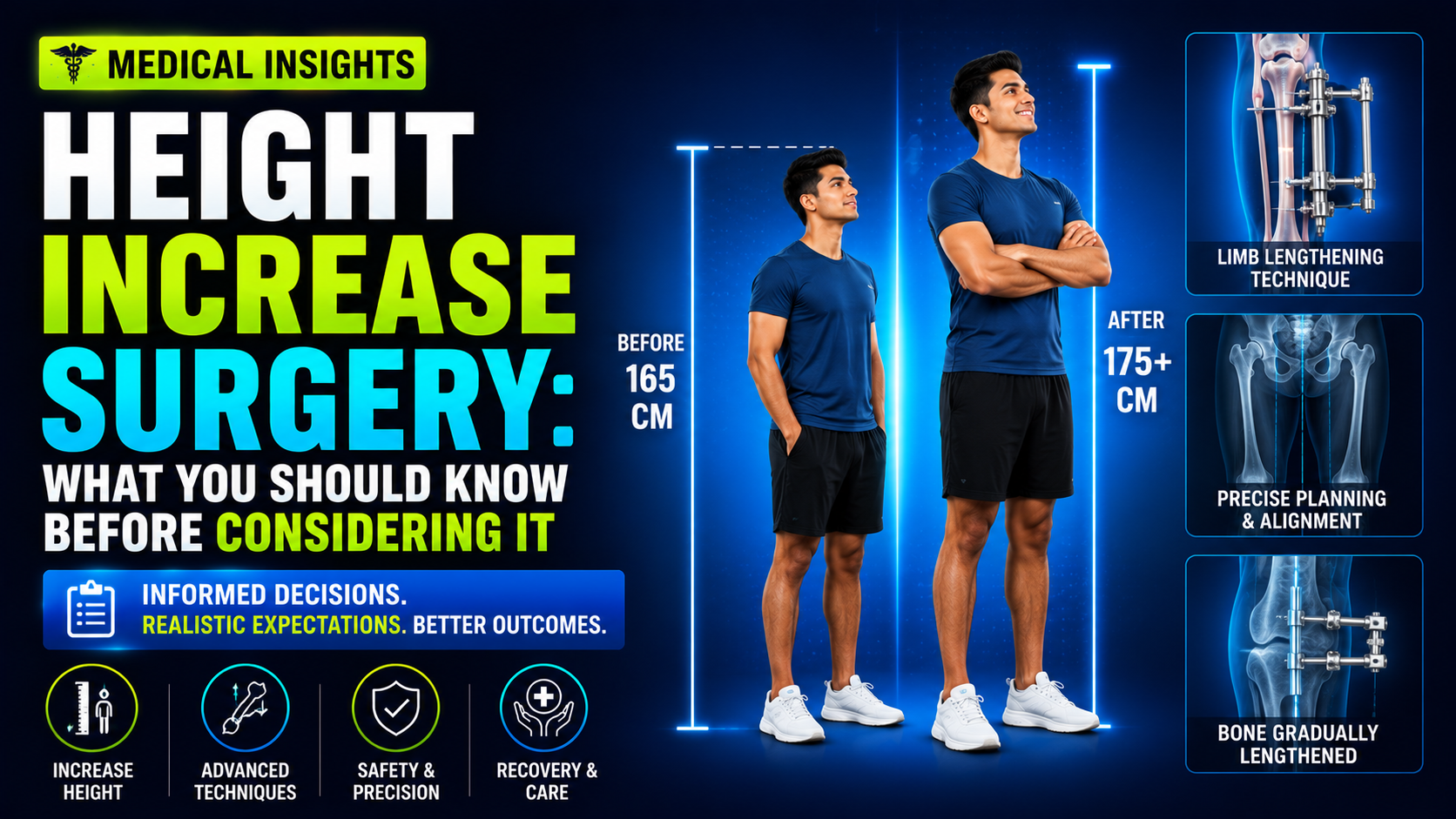
Before discussing safety, it helps to understand what the body is actually doing during this process. The surgeon makes a controlled cut in the bone, usually the femur or tibia, and a device, either an internal motorised nail or an external frame, gradually pulls the two segments apart at roughly 1 millimetre per day. As that gap widens, the body naturally fills it with new bone tissue, a biological process called distraction osteogenesis. Over the following months, that new bone hardens and matures into permanent, load-bearing bone.
This isn't an artificial implant replacing bone. It's your own body growing new bone in response to controlled mechanical stretching, which is part of why the procedure has held up so well clinically over the decades it's been studied.
What the Research Actually Shows
I'd rather point to data than reassurance. Published reviews of limb lengthening cases consistently show that complication rates rise with how much lengthening is attempted relative to the bone's original length, and fall sharply when treatment stays within recommended limits. One well-cited review of complications found that patients gaining under 15% of their original bone length had a meaningfully lower complication rate than those pushing past 30%, which is exactly why responsible surgeons cap lengthening per segment rather than trying to achieve everything in one stretch.
Reported success rates for properly performed procedures generally fall in the 85 to 95% range, with the original treatment goals achieved even in cases involving some complications along the way. That's not a claim of zero risk. It's a realistic picture of a procedure that works well when it's respected.
Where the Real Risks Lie
I think patients are better served by understanding risks clearly rather than having them glossed over. The genuine risks include:
Pin-site infection. With external fixators, pins pass through the skin into the bone, creating an entry point for bacteria. This is the most common complication reported in the literature, though it's usually minor and managed with cleaning and antibiotics. Fully internal systems, since there's no external hardware breaking the skin during the lengthening phase, largely avoid this risk.
Nerve and blood vessel tension. As the bone lengthens, the surrounding nerves and vessels have to stretch along with it. If the distraction rate is too aggressive, this can cause pain, numbness, or in rare cases, more lasting nerve issues. This is precisely why the standard rate of roughly 1mm per day exists, and why regular monitoring throughout the process matters so much.
Joint stiffness and muscle tightness. Lengthening puts new demands on the muscles and tendons crossing the joint. Without consistent physiotherapy, this can progress into contractures that are genuinely difficult to reverse later. This is the one risk that depends almost entirely on patient compliance rather than surgical skill.
Delayed bone healing. In a small percentage of cases, the new bone takes longer than expected to consolidate, or doesn't fill in fully. Smoking, poor nutrition, and not following weight-bearing instructions are the most common contributing factors here.
Minor length differences. After procedures on both limbs, small asymmetries under a centimetre are possible, though they're generally not noticeable in daily gait or function.
None of these risks are unique to limb lengthening as a category of surgery, they're the kind of considerations that come with any major orthopaedic procedure. What matters is whether the surgical team is set up to catch and manage them early.
Why the Surgeon and Centre Matter More Than the Technique
I've seen firsthand how much the outcome depends on who's performing the procedure and how the recovery is managed, not just which device is used. A center that treats limb lengthening as a specialty, with high case volume, weekly imaging, and physiotherapy built into daily care rather than treated as optional, sees a very different complication profile than one that performs it occasionally alongside general orthopaedic work.
This is also why international guidance, including warnings issued in the UK and UAE about lower-cost, less experienced clinics, keeps coming back to the same point: the risk isn't inherent to the surgery itself, it's concentrated in centres that cut corners on follow-up, use unreliable hardware, or lack the case experience to catch problems early.
At Heights Plus, one of India's top limb lengthening surgery centres, our approach is built directly around this. Every patient gets weekly surgeon reviews, regular X-ray and bone density monitoring, and twice-daily physiotherapy that isn't billed separately or treated as an add-on. We also stay within the well-established safety limit of roughly 6 to 8 cm of lengthening per bone segment, treating larger total gains as a staged process across multiple procedures rather than pushing a single bone past what it can safely tolerate.
Internal vs. External Devices: A Safety Comparison
Patients often ask whether internal nails like PRECICE, or external frames like LON and Ilizarov, are the "safer" option. The honest answer is that both are safe when used appropriately, but they carry different risk profiles:
- Internal nails avoid pin-site infection entirely since there's no hardware breaking the skin, but they involve a second procedure later to remove the nail, and cost more due to the imported hardware.
- External frames are more affordable and have decades of clinical data behind them, but require diligent daily pin-site care and carry a higher, though still manageable, infection risk.
Neither is universally "better." The right choice depends on the patient's anatomy, the amount of lengthening needed, and personal preference around visible hardware during recovery.
What Patients Can Do to Reduce Their Own Risk
Surgical skill and post-op monitoring account for a large part of safety, but patients themselves play a real role too:
- Attending every physiotherapy session, since skipped sessions are one of the most common causes of avoidable stiffness
- Following weight-bearing instructions exactly as given, rather than testing limits early
- Maintaining good nutrition to support bone healing
- Avoiding smoking, which measurably slows bone consolidation
- Reporting any unusual pain, numbness, or swelling immediately rather than waiting for a scheduled check-up
Patients who follow this closely tend to have noticeably smoother recoveries than those who treat the guidelines loosely.
Questions Worth Asking Any Clinic Before You Commit
Given how much the centre itself affects safety, I'd encourage anyone considering this procedure, anywhere in the world, to ask:
- How many limb lengthening procedures has the surgeon personally performed?
- Is physiotherapy included in the treatment plan, or billed as an extra?
- How often will bone growth be checked with imaging during recovery?
- What is the clinic's documented complication rate, and can they share outcome data?
- Is the hospital properly accredited for surgical safety standards?
A center confident in its safety record will answer these clearly and without hesitation.
Final Thoughts
Limb lengthening surgery is not risk-free, and I'd be doing patients a disservice to suggest otherwise. But the data is clear that when it's performed within established safety limits, by a surgeon with genuine experience in the procedure, and supported by consistent post-operative monitoring and physiotherapy, it carries a strong safety profile with success rates in the 85 to 95% range. The risks that do exist are well understood, well documented, and in the vast majority of cases, manageable when caught early.
If you're considering this procedure, the most important decision isn't which device to choose, it's which surgeon and centre you trust to manage your case from the first consultation through to full recovery.
Dr. Soumya Shrikanta Mohapatra is a Senior Orthopaedic and Limb Lengthening Surgeon at Heights Plus, one of India's top limb lengthening surgery centres, with fellowship training in Trauma, Ilizarov, and Deformity Correction from Australia and over 15 years of clinical experience.
Medical Disclaimer: This article is for general informational purposes only and does not constitute medical advice. Individual results and risks vary. Consult a qualified orthopaedic surgeon for a personalized evaluation before making any treatment decision.
Discussion
0 Comments
Leave a Comment
Your email address will not be published. Newsletter subscribers are auto-approved; others are moderated for safety.
Author ProfileView Portfolio

Dr. Soumya Shrikanta Mohapatra
MBBS, MS (Orthopaedics) – Orthopaedic Surgeon at Heights Plus“
MBBS (The Tamil Nadu Dr. M.G.R. Medical Univ) • MS Ortho (SMS Medical College, Jaipur) Fellowship Trained (Australia) – Trauma, Ilizarov & Joint Reconstruction